What Is Starbucks' New Seating Policy?
Imagine walking into a Starbucks, finding an empty chair, and sitting down to wait for a friend, check your phone, or get some work done. You haven't ordered a coffee or anything else. Is that still allowed?
For many Starbucks customers in China, the answer has recently changed.
Starting October 22, 2026, Starbucks China introduced a nationwide purchase-before-seating policy across its approximately 8,000 mainland China stores. Under the new rule, customers are expected to make a purchase before using the store's seating areas.
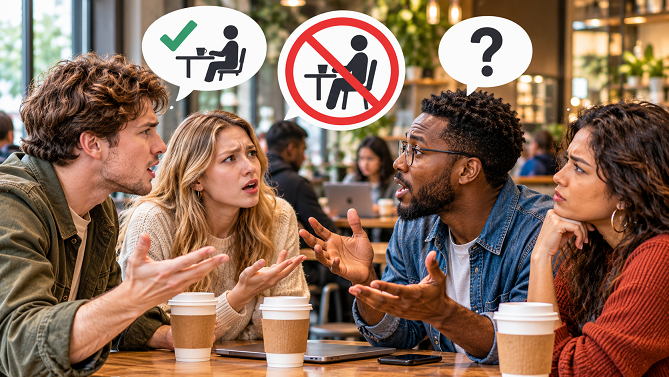
The change has sparked widespread discussion about whether coffee shops should function exclusively as places for paying customers or continue offering a welcoming environment where people can relax, socialize, and spend time.
Starbucks says the policy is intended to improve the in-store experience and ensure that customers who make purchases have access to available seating.
However, it also raises an interesting question: If Starbucks has always promoted itself as a "third place" between home and work, should everyone now have to buy something before sitting down?
Let's take a closer look at the new Starbucks seating policy, what customers should know, and why it has become such a controversial topic.
Can You Sit at Starbucks Without Buying Anything?
The most frequently asked question is straightforward: Can you still sit at Starbucks without buying anything?
Under Starbucks China's new policy, customers are expected to purchase something before taking a seat. The rule applies to its mainland China stores nationwide, rather than just a few selected locations.
Visit Seat or No Seat voting page and cast your vote to make your opinion heard!
This means that some familiar situations may no longer be acceptable:
- Walking into Starbucks just to sit down and use your phone.
- Occupying a table while waiting for someone without ordering anything.
- Using a table as a temporary workspace without making a purchase.
- Staying for an extended period while taking up seats that paying customers could use.
The main purpose is to prioritize seating for customers who actually purchase products.
However, Starbucks has also emphasized that employees should communicate with visitors politely and handle reasonable unexpected needs and special circumstances with flexibility.
For example, pregnant women and people with limited mobility should receive priority assistance.
Important: This policy concerns Starbucks stores in mainland China. It should not be interpreted as a universal seating rule for every Starbucks location around the world.
Do You Have to Buy a Coffee to Use Starbucks Seating?
Not necessarily. User can make their own coffe according to Coffee Recipe Generator
The policy is about making a purchase, not specifically purchasing a cup of coffee.
Customers who want to sit down may consider ordering other available products, such as:
- Espresso and Americano.
- Latte and cappuccino.
- Frappuccino and other specialty beverages.
- Tea and non-coffee drinks.
- Cakes, sandwiches, and other food items.
For example, someone who doesn't drink coffee could still choose a tea or a snack.
But does Starbucks require a specific minimum spending amount?
As of October 31, 2026, the publicly reported policy establishes the purchase-before-seating requirement, but does not specify a universal minimum spending amount for every customer.
Therefore, customers should check the notices at their local stores or ask staff if they are unsure.
The important distinction is that buying a product is the stated requirement; purchasing an expensive coffee is not.
How Long Can You Stay at Starbucks After Buying a Drink?
Another question customers frequently ask is whether purchasing one drink allows them to stay for an unlimited amount of time.
For example:
- Can you buy one latte and work for two hours?
- Can you sit in Starbucks all afternoon after ordering a coffee?
- Can you use a table for an online meeting?
- Can you continue studying after finishing your drink?
The new purchase-before-seating policy does not, by itself, establish a universal 90-minute or two-hour seating limit.
However, that doesn't necessarily mean every customer can occupy a table indefinitely.
Store conditions, seating availability, and individual store arrangements can affect the experience. During busy periods, customers should be considerate of others and avoid unnecessarily occupying large tables or multiple seats.
Here are a few practical suggestions:
- Choose a table that matches the size of your group.
- Avoid occupying several seats with personal belongings.
- Keep your conversations and electronic devices at a reasonable volume.
- Be considerate of customers looking for somewhere to sit.
- Ask store employees if you are unsure about local seating arrangements.
Ultimately, buying a drink is the first step, but respecting the shared space is also important.
What About Restrooms, Pregnant Women, and People Who Need a Rest?
One of the biggest concerns surrounding the Starbucks seating policy is how it affects people who may need temporary assistance.
Not everyone entering a coffee shop is necessarily looking for a place to enjoy a beverage.
Some people may need to rest because they are tired, pregnant, elderly, or experiencing mobility difficulties.
Starbucks China has specifically said that employees should prioritize helping pregnant customers and people with limited mobility.
The company has also instructed employees to communicate in a friendly manner and handle reasonable unexpected needs and special circumstances appropriately.
This suggests that the policy is not intended to be applied without considering individual circumstances.
Can Pregnant Women Sit at Starbucks Without Buying Anything?
Starbucks China has explicitly identified pregnant women as customers who should receive priority assistance.
This is an important consideration because someone who needs a temporary place to rest may not always be able to make a purchase first.
Can Elderly People or People With Disabilities Use Starbucks Seating?
People with limited mobility are also specifically mentioned in Starbucks China's guidance.
The company says these customers should receive priority assistance.
For other situations, visitors can explain their needs to store employees and ask for help.
Can You Use Starbucks Restrooms Without Buying Anything?
This is a separate question from the seating policy.
The October 2026 announcement focuses on purchasing before using seating. It does not establish a detailed, universal public-restroom access rule for every mainland China store.
Customers should not automatically assume that every restroom has identical access conditions. Local store arrangements may differ.
Why Is Starbucks Changing Its Seating Policy?
Why would a coffee company that has spent years encouraging customers to stay longer suddenly require them to purchase something before sitting down?
There are several important reasons behind this decision.
1. Protecting Seats for Paying Customers
One of the most obvious reasons is seating availability.
Imagine visiting Starbucks during the afternoon rush. You order a coffee, but every table is occupied.
Some people are working on laptops, others are talking on their phones, and some have been sitting there for hours without ordering anything.
For paying customers, this can be frustrating.
A purchase-before-seating rule gives Starbucks a clearer way to prioritize the people who are supporting the business.
2. Managing Long-Term Seat Occupation
Starbucks stores are not traditional public libraries or free coworking spaces.
Tables, chairs, electricity, air conditioning, cleaning, and employee services all come with operating costs.
When visitors occupy tables for extended periods without making purchases, the business may struggle to balance customer hospitality with commercial operations.
This issue becomes particularly noticeable in stores with limited seating.
3. Responding to Competition From Local Coffee Brands
The Chinese coffee market has become increasingly competitive.
Brands such as Luckin Coffee have attracted customers with relatively affordable drinks, convenient mobile ordering, and rapid store expansion.
Starbucks, meanwhile, has traditionally positioned itself around a more complete in-store experience.
In this environment, improving the experience for customers who choose to visit and spend time in Starbucks stores is an important part of its business strategy.
4. Improving the Overall Store Experience
Interestingly, the seating policy was announced alongside another major commitment.
Starbucks China said it would invest more than 300 million yuan in fiscal 2027 to improve its store experience.
The investment includes:
- Adding more employees during peak hours.
- Improving digital systems.
- Upgrading important store equipment.
- Renovating approximately 1,000 stores.
- Improving service efficiency and the in-store environment.
This shows that Starbucks is not simply changing who can sit down. It is also trying to improve the experience customers receive after entering its stores.
Why Are Customers Debating the New Rules?
The Starbucks seating policy has generated different reactions among customers.
Some people believe the rule is reasonable, while others worry that it could undermine the brand's welcoming atmosphere.
Here are the two main sides of the debate.
Why Some Customers Support the New Seating Policy
Supporters argue that Starbucks is a commercial business, not a free public lounge.
Their arguments include:
- Paying customers should have a reasonable opportunity to find seats.
- People should not occupy tables for hours without purchasing anything.
- Employees should not have to deal with excessive seat occupation.
- A clear policy can reduce disagreements between customers and staff.
- Better seating availability could improve the overall customer experience.
From this perspective, the new rule is simply about fairness.
If someone purchases a drink and wants to enjoy it inside the store, they should have a reasonable chance of finding a seat.
Why Other Customers Disagree
Not everyone is happy about the change.
Some customers believe that Starbucks has built its reputation on providing more than coffee.
Their concerns include:
- The policy may make Starbucks feel less welcoming.
- People who only need a short rest may feel uncomfortable entering.
- Customers may become less willing to spend time inside stores.
- The traditional idea of Starbucks as a third place could be weakened.
- Strict enforcement could create unnecessary conflicts between employees and visitors.
For these customers, the appeal of Starbucks has always included the freedom to relax and spend time in a comfortable environment.
Requiring a purchase before sitting down may change that perception.
Is Starbucks Losing Its Third Place Identity?
One of the most interesting parts of this debate is the concept of the "third place."
The term refers to a social environment outside the two main places where people spend their lives: home and work.
For many customers, Starbucks has traditionally served this purpose.
It is somewhere people can:
- Meet friends and family.
- Study for exams.
- Work remotely.
- Read books.
- Have casual business meetings.
- Relax between appointments.
- Spend time away from home or the office.
This concept has been a major part of Starbucks' brand identity for years.
However, there is a difference between welcoming customers and providing unlimited free access to commercial space.
A coffee shop still needs to cover its operating costs, manage seating availability, and provide a good experience for paying customers.
The real challenge for Starbucks is finding the right balance.
Can it remain a welcoming third place while ensuring that customers who purchase drinks and food can actually find somewhere to enjoy them?
That is perhaps the most important question raised by the new seating policy.
What Does Starbucks' New Seating Policy Mean for Customers?
For customers visiting Starbucks in mainland China, the most practical takeaway is simple: if you plan to sit inside, be prepared to make a purchase first.
Here is a quick summary:
| Customer Situation | What to Know |
|---|---|
| Want to sit without ordering | A purchase is expected before taking a seat |
| Don't drink coffee | Other available food and drinks may be purchased |
| Want to work on a laptop | Make a purchase and respect shared seating |
| Want to stay for several hours | No universal time limit was specified in the announcement |
| Pregnant visitors | Priority assistance should be provided |
| People with limited mobility | Priority assistance should be provided |
| Need to use the restroom | Check the individual store's arrangements |
The policy applies to Starbucks stores in mainland China. Starbucks locations in other countries may have different rules.
For customers, understanding the local policy before visiting can help avoid awkward situations.
For Starbucks, the challenge will be implementing the rule consistently without losing the welcoming atmosphere that helped make its stores popular in the first place.
Frequently Asked Questions (FAQ)
1. Can You Sit at Starbucks Without Buying Anything in China?
Starting October 22, 2026, Starbucks China introduced a nationwide purchase-before-seating policy. Customers are expected to make a purchase before using seating areas in its mainland China stores.
2. Do You Have to Buy Coffee to Sit at Starbucks?
No. The requirement is to make a purchase, not necessarily to buy coffee. Customers may choose from available drinks, tea, snacks, cakes, and other food items.
3. How Much Do You Have to Spend to Sit at Starbucks?
The publicly announced policy does not specify a universal minimum spending amount. Customers should check with their local Starbucks store for clarification.
4. Can You Work at Starbucks All Day After Buying One Drink?
The new policy does not establish a universal maximum stay duration. However, customers should respect store conditions, seating availability, and other visitors.
5. Can You Sit at Starbucks If You Are Pregnant?
Yes, Starbucks China has specifically stated that pregnant women should receive priority assistance. Employees are expected to handle such situations with consideration.
6. Does Starbucks Allow People With Disabilities to Sit Without Buying Anything?
Starbucks China has identified people with limited mobility as visitors who should receive priority assistance. Customers who need help can explain their circumstances to store employees.
7. Does Starbucks Have the Same Seating Policy in Every Country?
No. The October 2026 purchase-before-seating policy discussed in this article applies to Starbucks stores in mainland China. Policies in other markets may differ.
8. Why Did Starbucks Introduce the New Seating Policy?
The company aims to prioritize paying customers, improve seating availability, and create a better in-store experience amid increasing competition in China's coffee market.
Final Thoughts
Starbucks' new seating policy is more than a simple change to store rules. It highlights a bigger debate about the relationship between businesses and the public spaces they create.
On one side, customers who purchase drinks deserve a reasonable opportunity to enjoy their time inside the store. On the other, Starbucks has built much of its identity around being a comfortable place to meet, work, and relax.
Perhaps the best solution is not simply choosing between free seating and strict purchase requirements, but finding a balance between commercial sustainability and genuine hospitality.
What do you think? Should Starbucks require everyone to buy something before sitting down, or should people still be allowed to use empty seats when the store is quiet?
Visit our Seat or No Seat voting page and cast your vote to make your opinion heard!